
CRASH COURSE: INTRODUCTION & STRUCTURE OF MACROECONOMICS
NOTES
Meaning of Macroeconomics
Macroeconomics is the branch of economics that studies the economy as a whole rather than individual units.
It focuses on:
- National Income
- Aggregate Employment
- General Price Level
- Aggregate Consumption
- Aggregate Investment
- Economic Growth
Main Tools of Macroeconomics:
- Aggregate Demand (AD)
- Aggregate Supply (AS)
Also Known As:
- Income Theory
- Employment Theory
👉 Unlike microeconomics (which studies individual consumers or firms), macroeconomics examines overall economic performance and economy-wide phenomena.
Structure of Macroeconomics
(Sectors of the Economy)
Macroeconomics studies the economy by dividing it into different sectors. This classification helps us understand who produces goods and services, who consumes them, and how income flows within the economy.
Major Sectors of an Economy
(a) Producer Sector
- Engaged in the production of goods and services
- Includes firms, factories, and industries
(b) Household Sector
- Engaged in consumption of goods and services
- Households are the owners of factors of production:
- Land
- Labour
- Capital
- Entrepreneurship
(c) Government Sector
Performs public activities such as:
- Tax collection
- Providing subsidies
- Public expenditure on welfare and development
(d) Rest of the World Sector
- Exports of goods and services
- Imports of goods and services
(e) Financial Sector (Financial System)
- Borrowing
- Lending
- Credit creation
👉 These sectors interact continuously with each other, giving rise to the circular flow of income in the economy.
Circular Flow of Income – Meaning
Circular Flow of Income refers to the continuous movement of income, goods, and services among different sectors of the economy in a circular manner.
This concept explains how money and real resources flow between households, firms, government, and other sectors of the economy.
Types of Flows in Circular Flow of Income
1. Real Flow (Physical / Product Flow)
- Flow of goods and services from producers to consumers
- Flow of factors of production (land, labour, capital, entrepreneurship) from households to firms
2. Money Flow (Monetary / Nominal Flow)
- Flow of money income such as wages, rent, interest, and profit
- Flow of money expenditure on goods and services
👉 Real flow and money flow move in opposite directions, together forming the circular flow of income in an economy.
Real Flow (Physical Flow)
Meaning
Real Flow shows the actual flow of goods, services, and factor services between different sectors of the economy.
Two-Sector Economy (Simple Economy)
In a two-sector economy, economic activities are studied by considering only two sectors.
Sectors Involved:
- Household Sector
- Producer Sector
Real Flow Explanation
- Households supply factor services such as labour, land, capital, and entrepreneurship to producers.
- Producers supply goods and services to households for consumption.
👉 This real flow shows the mutual dependence between households and firms in the economy.
Money Flow (Nominal Flow)
Meaning
Money Flow, also known as Nominal Flow, refers to the flow of money payments between different sectors of the economy.
Explanation
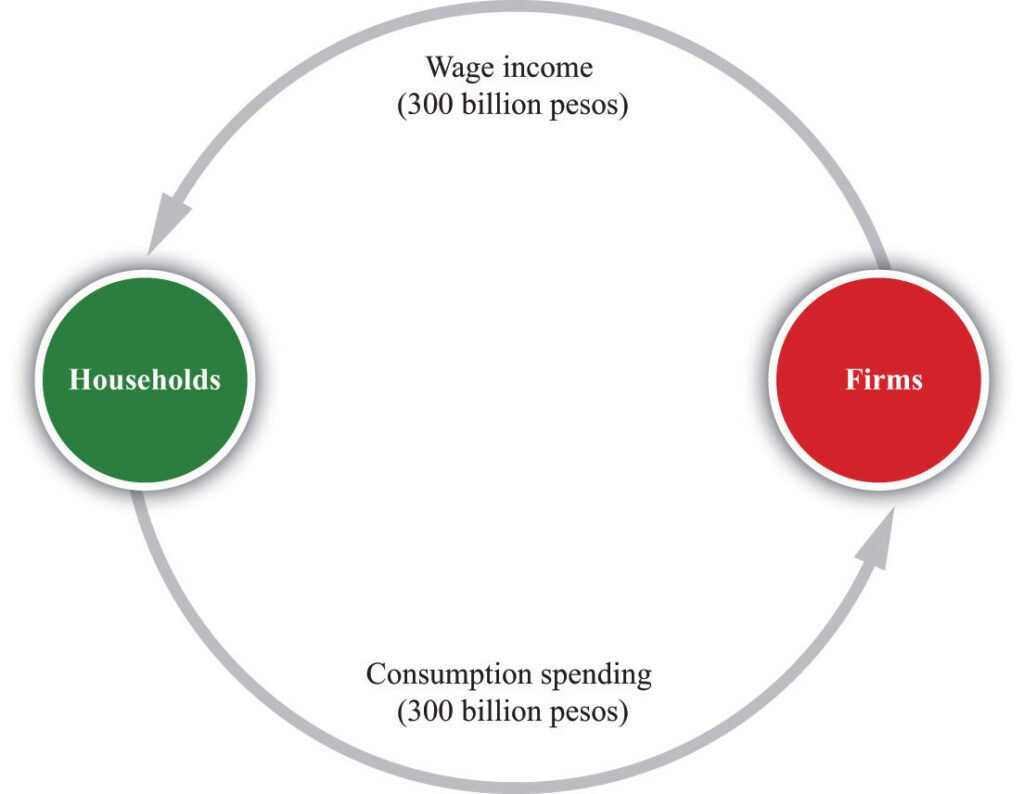
- Firms pay factor incomes such as wages, rent, interest, and profit to households.
- Households spend this income on goods and services produced by firms.
- Money flows back to firms in the form of consumption expenditure.
👉 Money flow moves in the opposite direction to real flow, together forming the circular flow of income in a two-sector economy.
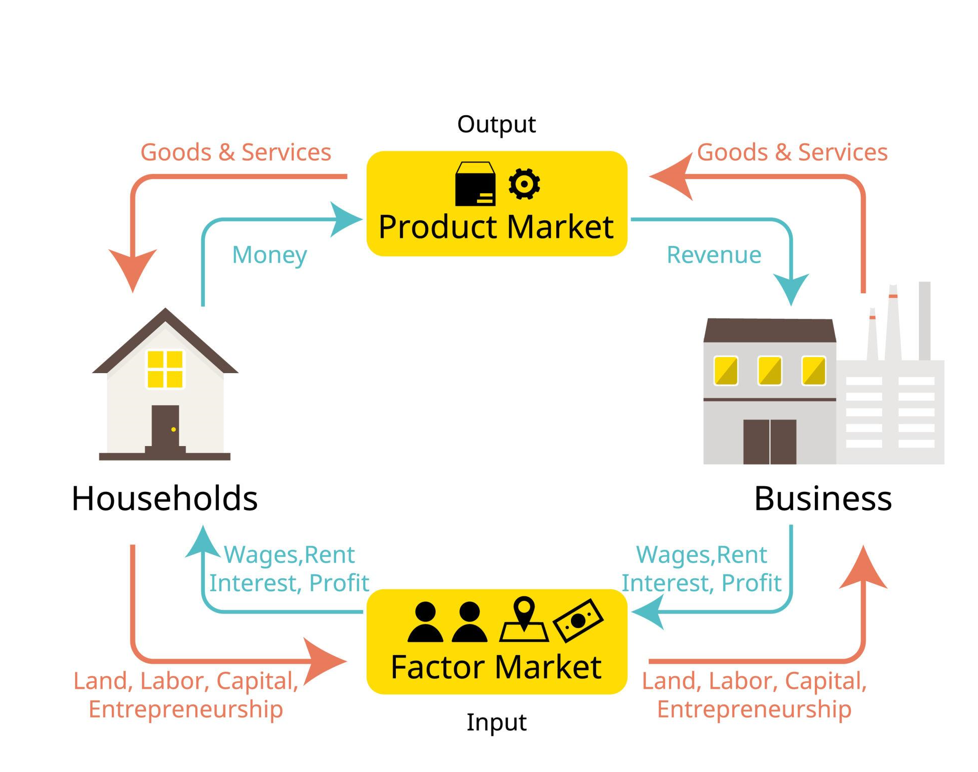
Circular Flow of Income in Two-Sector Model
Assumptions
- Only two sectors exist: Households and Firms
- Households supply factor services
- Firms hire factor services for production
- Households spend their entire income on consumption
- Firms sell all output to households
- No government sector
- No foreign trade
Two Markets in the Economy
1. Product Market
- Goods and services are bought and sold
- Households demand goods and services
- Firms supply goods and services
2. Factor Market
- Factors of production are exchanged
- Households supply factor services
- Firms demand factor services
Key Results of Two-Sector Model
- Total production = Total consumption
- Factor payments by firms = Factor income of households
- Household expenditure = Firm income
- Real flows = Money flows
👉 Under these assumptions, the circular flow of income remains continuous and balanced in a two-sector economy.
Phases of Circular Flow of Income
(i) Production Phase
- Production of goods and services by firms
- Real Flow → Quantity of output produced
- Money Flow → Value of output produced
(ii) Distribution Phase
Distribution of income to factor owners in the form of:
- Wages
- Rent
- Interest
- Profit
This phase represents a purely money flow in the economy.
(iii) Disposition Phase
- Expenditure on goods and services by households and other sectors
- Money flows back to producers as consumption expenditure
👉 These three phases together ensure the continuous circulation of income in the economy.
Factor Income
Meaning
Factor Income refers to the income earned by factors of production for rendering productive services in the process of production.
Features of Factor Income
- Bilateral (Two-Sided): There is a mutual relationship between the factor owner and the producer.
- Included in National Income: Factor incomes are counted while estimating national income.
Examples of Factor Income
- Wages
- Rent
- Interest
- Profit
Transfer Income
Meaning
Transfer Income refers to income received by individuals or institutions without providing any productive services in return.
Features of Transfer Income
- Unilateral (One-Sided): Income is received without any corresponding contribution to production.
- Not Included in National Income: Transfer incomes do not add to current production.
Examples of Transfer Income
- Old age pension
- Scholarships
- Unemployment allowance
Types of Transfers
(i) Current Transfers
- Made from current income
- Regular or recurring in nature
- Generally used for consumption
- Examples: Pensions, scholarships, gifts
(ii) Capital Transfers
- Made from savings or wealth
- Non-recurring in nature
- Generally used for investment purposes
- Examples: Investment grants, war damages
Stock and Flow
Stock
- Measured at a point of time
- Static in nature
- No time dimension
Examples of Stock:
- Money supply
- Water in a tank
Flow
- Measured over a period of time
- Dynamic in nature
- Has time dimension
Examples of Flow:
- Income
- Exports
- Spending
Economic (Domestic) Territory
Definition (UN)
Economic territory is the geographical area in which persons, goods, and capital move freely under the control of the government.
Included in Economic Territory
- Ships and aircrafts operated by residents of the country
- Fishing vessels operating in international waters
- Oil rigs and offshore platforms owned by residents
- Embassies and military establishments of the country located abroad
Excluded from Economic Territory
- Foreign embassies located within India
- International organisations such as UNO, WHO, IMF
Citizenship vs Normal Resident
Citizenship
- A legal concept
- Based on birth, descent, or law
- Determined by the constitution and legal provisions
Normal Resident
- An economic concept
- Centre of economic interest lies in the country
- Lives in the country for more than one year
- Engaged in regular economic activities
👉 Foreigners can be normal residents if their centre of economic interest lies in the country, whereas citizens may be non-residents (e.g., NRI).
Final Goods
Meaning
Final Goods are goods that are used either for personal consumption or for investment (capital formation).
Features of Final Goods
- No further processing is required
- Provide direct satisfaction to consumers
- They cross the production boundary
Examples of Final Goods
- Bread bought by a consumer
- Machinery bought by a firm
Intermediate Goods
Meaning
Intermediate Goods are goods that are used for further processing or for resale within the same year.
Features of Intermediate Goods
- Provide indirect satisfaction to consumers
- Do not cross the production boundary
Examples of Intermediate Goods
- Sugar used in making sweets
- Car purchased by a dealer for resale
Final vs Intermediate Goods – Key Rule
👉 The use of a good determines whether it is classified as a final good or an intermediate good, and not the good itself.
Example:
- Bread eaten by a consumer → Final Good
- Bread used by a restaurant → Intermediate Good
Production Boundary Concept
The Production Boundary is an imaginary line drawn around production units to distinguish between final goods and intermediate goods.
- Goods that cross the production boundary are treated as final goods.
- Goods that remain within the production boundary are treated as intermediate goods.
Intermediate Consumption of Government
Includes:
- Non-durable goods and services
- Repairs and maintenance of government assets
- Military equipment such as weapons
- Expenditure on research and development (R&D) and advertisements
- Employee travel and entertainment expenses
Excludes:
- Goods and services distributed directly to households as final consumption
Classification of Final Goods
(A) Consumption Goods
Consumption goods are final goods that directly satisfy the wants of consumers.
Types of Consumption Goods
- Durable Goods: Cars, air conditioners (ACs)
- Semi-Durable Goods: Clothes, furniture
- Non-Durable Goods: Food items, milk
- Services: Education, transport
(B) Capital Goods
Capital goods are final goods used for future production of other goods and services.
- Machinery, buildings, roads
- Stocks held by producers
- Subject to depreciation over time
Key Exam-Friendly “Words That Matter”
The following keywords are frequently used in definitions, explanations, and numericals. Using them correctly improves answer quality and marks.
- Circular flow of income
- Real flow
- Money flow
- Factor income
- Transfer income
- Current transfer
- Capital transfer
- Final goods
- Intermediate goods
- Consumption goods
- Capital goods
ONE-PAGE REVISION NOTES (EXAM READY)
Macroeconomics
- Studies the economy as a whole
- Deals with national income, employment, and price level
- Also called Income Theory / Employment Theory
- Main tools: Aggregate Demand (AD) and Aggregate Supply (AS)
Structure of Economy (Sectors)
- Household Sector: Consumes goods, owns factors of production
- Producer Sector: Produces goods and services
- Government Sector: Taxes, subsidies, public expenditure
- Rest of the World: Exports and imports
- Financial Sector: Borrowing and lending
Circular Flow of Income
- Continuous flow of income and goods among different sectors
- Real Flow: Flow of factor services and goods
- Money Flow: Wages, rent, interest, profit and expenditure
Two-Sector Model – Assumptions
- Only households and firms exist
- No government and no foreign trade
- Households spend entire income
- Firms sell entire output
Phases of Circular Flow
- Production Phase: Production of goods and services
- Distribution Phase: Distribution of factor income
- Disposition Phase: Expenditure on goods and services
Factor Income
- Earned by rendering productive services
- Included in National Income
- Examples: Wages, rent, interest, profit
Transfer Income
- Received without productive services
- Not included in National Income
- Current Transfers: Pension, scholarship
- Capital Transfers: Investment grants
Stock vs Flow
- Stock: Measured at a point of time (Money supply)
- Flow: Measured over a period of time (Income)
Final Goods
- Used for consumption or investment
- Cross the production boundary
Intermediate Goods
- Used for resale or further processing
- Do not cross the production boundary