
Chapter 2 Indicators of Growth and Development

Chapter 2 Indicators of Growth and Development
1. Choose the correct option for the following questions :
1. Development is a multi dimensional process. Who has given this statement?
(a) Todaro
(b) Kindleberger
(c) Marshall
(d) Machlup
2. Which concept is qualitative?
(a) National Income growth rate
(b) Per capita Income growth rate
(c) Economic growth
(d) Economic development
3. What was India’s ranking in the world according to the Human Development Index in 2014?
(a) 127
(b) 128
(c) 129
(d) 130
4. What was the per capita income of India in US dollars according to the Human Development Report of 2014?
(a) 7110
(b) 7068
(c) 480
(d) 5497
5. When economic development takes place in a country
(a) Contribution of agricultural sector decreases.
(b) Contribution of agricultural sector increases.
(c) Contribution of industrial sector decreases.
(d) Contribution of service sector decreases.
6. What is the maximum value of Physical Quality of Life Index (PQLI)
(a) less than 100
(b) more than 100
(c) 100
(d) zero
7. What is the value of Human Development Index?
(a) 0
(b) 1
(c) between 0 & 1
(d) 100
8. Generally which countries are related with the concept of economic growth?
(a) Developed
(b) Developing
(c) Backward countries
(d) Third world countries
9. Economic development is the ____ of economic growth.
(a) Cause
(b) Result
(c) Means
(d) End
10. ____ was first in Human Development Index according to 2014 report.
(a) Japan
(b) Norway
(c) America
(d) India
2. Answer the following questions in one line:
Q1. What is Economic growth?
Answer:
Economic growth refers to the increase in the total output of an economy over the long term. This means there is a steady rise in real national income and real per capita income, which we define as economic growth.
Q2. Give the meaning of Economic development?
Answer:
Economic development means the process through which a country enhances the economic, political, and social welfare of its citizens.
Q3. What is per capita income?
Answer:
Per capita income is the figure derived by dividing a country’s total national income by its total population.
Q4. Why is per capita as an indicator more effective than national income as an indicator?
Answer:
Per capita income includes population in its calculation, which national income ignores, making it a more accurate measure of development.
Q5. Which economist presented the Physical quality of life index?
Answer:
The economist who introduced the Physical Quality of Life Index is Morris Davis Morris.
Q6. How many countries were included in the HDI of 2014?
Answer:
A total of 188 countries were covered in the Human Development Index published for the year 2014.
Q7. Which factors are included in the Human Development Index?
Answer:
The Human Development Index takes into account life expectancy, level of education, and income.
Q8. What is Infant mortality rate?
Answer:
Infant mortality rate refers to the number of infants dying before turning one year old, per 1,000 live births.
Q9. State the maximum value in Human Development Index.
Answer:
The highest attainable score in the Human Development Index is 1.
Q10. What does high per capita income indicate?
Answer:
A high per capita income shows that the country has experienced economic growth or development over time.
Q11. Sanitation facility indicates which aspect of improvement?
Answer:
Sanitation facility reflects a qualitative improvement in the living conditions and public health of a society.
3. Answer the following questions in brief:
Q1. State the limitations of National Income as an indicator.
Answer:
Using the growth in national income as a measure of economic development has some important drawbacks, explained as follows:
Difficulty in estimating accurate national income:
Issues like double counting, products for self-use, depreciation calculation, black income, tax evasion, barter system, illiteracy, and people having multiple jobs make it hard to calculate the actual national income. Hence, national income cannot truly reflect the development rate.Population:
Knowing just the national income doesn’t help understand development unless we also consider the population. If population grows faster than income, development is negative; if income grows faster, development is positive. But national income calculation does not include population, making it an incomplete indicator.Different calculation methods:
National income is calculated using various methods like (a) Production, (b) Income, and (c) Expenditure methods. Each country uses a different approach, so comparing development between countries using national income becomes problematic.
Q2. State the limitations of per capita income as an indicator.
Answer:
Only estimated values:
National income is usually calculated every year, but population figures are not. In India, census occurs every 10 years, so population estimates are used for the other years. Therefore, per capita income figures for non-census years are approximate.Difficulties in accurate calculation:
Whether to use current prices or constant prices for per capita income causes confusion, making it hard to judge the real situation.Shows only average income:
Per capita income just shows the average by dividing total income by population. It does not reflect how that income is distributed. If income is unevenly spread, a rise in per capita income doesn’t mean better development.Hard to compare internationally:
Every country reports per capita income in its own currency. For comparison, it must be converted to US dollars, but exchange rates are controlled differently in different countries, making real comparisons inaccurate.Not actual individual income:
Per capita income doesn’t reflect the real income people receive. It hides more information than it reveals, so it’s not a reliable development indicator.
Q3. Where do the quantitative and qualitative changes occur?
Answer:
Economic development brings both quantitative and qualitative changes. A rise in output shows quantitative change, while research and innovation improve quality—showing qualitative change. Still, the focus is more on qualitative improvement.
Q4. What type of change is rise in production?
Answer:
A rise in production is a quantitative change, as it shows an increase in the output level or quantity of goods and services.
Q5. What are the various indicators of Economic development?
Answer:
The key indicators of economic development include:
Growth of national income
Growth of per capita income
Physical Quality of Life Index (PQLI)
Human Development Index (HDI)
Gender Development Index (GDI)
Technological Achievement Index (TAI)
Human Poverty Index (HPI)
Human Consumer Index (HCI)
Q6. State the limitations of Economic growth.
Answer:
Economic growth only considers numerical increase. It shows a rise in national and per capita income but ignores institutional and mental changes. Thus, growth is a narrow concept and doesn’t explain people’s well-being effectively.
Q7. State the limitations of development.
Answer:
Though broader than growth, development can’t show real human progress. It’s not clear whether development actually improves lives.
Unlike economic growth, development is hard to measure because it involves social changes that are difficult to quantify.
Even when economic development occurs, people’s living standards may not rise equally. So, development doesn’t always ensure better lifestyles.
Q8. What is life expectancy at birth?
Answer:
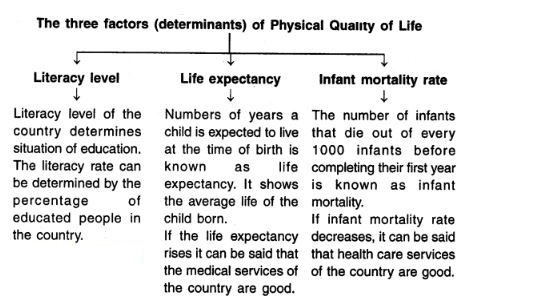
Morris used three indicators to calculate the Physical Quality of Life Index:
Literacy,
Life expectancy at birth, and
Infant mortality rate.
So, PQLI = Literacy Index + Life Expectancy Index + Infant Mortality Index.
Q9. Between growth and development, which one is difficult to measure? Why?
Answer:
Development is harder to measure than growth. Growth is numerical and measured through data like national or per capita income. But development is qualitative—like improvement in lifestyle or health—which is complex and not easily measurable.
Q1. What is Physical Quality of Life? What are the aspects included in it?
Answer:
Physical Quality of Life:
The physical quality of life of individuals depends on the types of goods and services consumed over time. The term ‘standard of consumption’ refers to the quantity and variety of goods and services used by an individual or a group within a specific period. It includes:
Consumption of food, fuel, and other non-durable goods
Use of durable and semi-durable goods
Consumption of services
The overall standard of living is directly linked to the physical quality of life. If the living standard rises, we can say that the physical quality of life has improved.
Aspects included in Physical Quality of Life:
The physical quality of life is determined by the types of goods and services used by individuals annually. Key aspects include:
Food intake (calories, proteins, fats)
Health services (doctor-population ratio)
Housing and clothing (rooms per house, persons per room)
Education and entertainment (access to schooling, TV, theatres, etc.)
Transport, communication, and information services (road, railway, telephones per capita)
Energy consumption (per capita use)
Access to safe drinking water
Life expectancy at birth
Infant mortality rate
Proper drainage facilities
If these 10 aspects show improvement, it indicates better physical quality of life. If not, these areas need to be studied, and corrective steps taken for development.
Each indicator can be measured relatively. Values are scaled from 0 to 100. The best-performing country in each indicator gets 100 points. Developed countries often give more focus to improving these indicators.
Q2. Discuss national income as an indicator of economic development.
Answer:
Growth Rate of National Income:
National income serves as a development indicator by reflecting a steady increase in a country’s real national income over time. If real income continues to grow, the country is considered to be progressing economically. A higher growth rate means rapid development, while slow growth implies slow development. If there’s no rise, development is stagnant; if it falls, it suggests negative development.
To evaluate this, real income is considered rather than nominal income, which means national income is calculated at constant prices, excluding inflation.
National Income and Development – Table:
Different countries show varying growth in national income. Countries like Norway and the USA may show slower growth compared to India, but this is due to their already advanced economies. India’s national income grew at 7.3%, reflecting faster growth.
| Country | Annual Growth Rate of National Income (%) |
|---|---|
| Norway | 2.2 |
| America | 2.4 |
| Sri Lanka | 4.5 |
| China | 7.3 |
| India | 7.3 |
| Pakistan | 4.7 |
Question 3.
Explain per capita income as an indicator of economic development.
Answer:
Per Capita Income as an Indicator:
Per capita income is derived by dividing a country’s gross national income by its total population. It reflects the average income of individuals and includes population factor, making it a more accurate indicator than national income.
According to this measure, if a country’s per capita income grows steadily over a long time, it signals economic development. The United Nations recommends using per capita income to assess development.
A high and growing per capita income shows fast development; a slow rise indicates slow development; no growth shows stagnation, and a decline reflects negative development.
The main aim of development is to enhance people’s living standards and human well-being. Per capita income effectively measures progress toward this goal.
Table: Per Capita Income and Growth in 2014 (PPP)
| Country | Per Capita Income (US $) | Growth Rate (%) |
|---|---|---|
| Norway | 64,992 | 1.1 |
| America | 52,947 | 1.6 |
| Sri Lanka | 9,779 | 3.5 |
| China | 12,547 | 6.7 |
| India | 5,497 | 6.0 |
| Pakistan | 4,866 | 2.6 |